Musée de Grenoble, Grenoble (FR) 30 May 2026 - 30 August 2026
Léon Tutundjian. Poétique du Cosmos
From May 30 to August 30, 2026, the Musée de Grenoble presents the exhibition Léon Tutundjian. Poétique du Cosmos, the very first retrospective featuring more than one hundred and thirty works spanning five decades of creation. For this occasion, the Fondation Gandur pour l'Art is lending a work by this pioneering artist of European Abstraction.
Curator: BRIGITTE LEAL, SOPHIE BERNARD
The exhibition chronologically traces Léon Tutundjian’s artistic journey through a selection of drawings, collages, reliefs, and paintings. From the 1920s onward, the artist explored the dialogue between art, science, and nature, seeking to combine scientific rigor with a dreamlike universe, between emotion and reason. Of Armenian origin, Léon Tutundjian studied at the School of Fine Arts in Constantinople before settling in Paris in 1923. From their founding in 1930 and 1931, he joined the Art Concret and Abstraction-Création groups, within which his abstract work stood out immediately for its originality, placing him alongside his contemporaries Auguste Herbin, Theo van Doesburg, and Jean Hélion, at the heart of the Parisian avant-garde.
Several themes run through his work, including geometric abstraction and cosmic abstraction. His period devoted to collage constitutes a key moment in his practice and reflects his assimilation of synthetic cubism and surrealist collage.
Created around 1925–1926, the work lent by the Foundation belongs to Tutundjian's early Parisian years. It is unquestionably the most ambitious work in the group of Papiers collé with a pronounced pictorial character. Far from merely revisiting the illustrious models developed between 1912 and 1917 by Georges Braque, Pablo Picasso, and later Juan Gris and Henri Laurens, its composition propels him toward the geometric absolute, of which Tutundjian would become, in 1930, one of the leading proponents under the banner of Art Concret.
Other themes are also explored in the rest of his work, notably biomorphic art, which he approached through an organic formal language, in a constant pursuit of balance and synthesis.

MUSÉE DE GRENOBLE
5 Place de Lavalette
38000 Grenoble
France
Work on loan
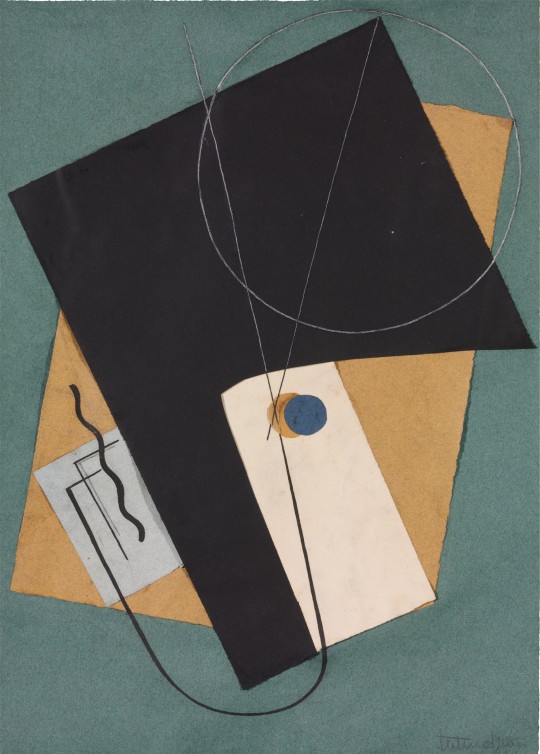
[Sans titre]
1925-1926